Problem addressed by this page
When a lithium battery becomes unstable, the consequences are not limited to the stored product. Fire, smoke, gases and propagation can affect nearby buildings, critical equipment and site operations.
Risk separation
Outdoor storage moves lithium risk away from the main building and creates a dedicated, clearly defined and controllable area.
Request a technical assessment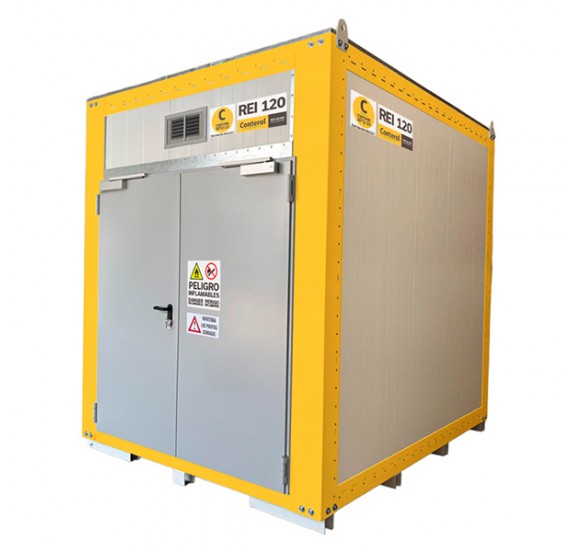
When a lithium battery becomes unstable, the consequences are not limited to the stored product. Fire, smoke, gases and propagation can affect nearby buildings, critical equipment and site operations.
Safe outdoor storage, REI120 fire-resistant compartmentation and risk separation are key considerations. An independent area is often more suitable than storage integrated into the building when the aim is to reduce exposure of the main facilities.
Depending on volume, battery condition and site constraints, storage can be based on a compact, large-capacity or modular walk-in range.
Group 01
Small volumes, initial quarantine and segregated storage in drums or IBCs.
View detailsGroup 02
Industrial storage for medium or high volumes, at ground level or on two levels.
View detailsGroup 03
Walk-in modules for internal handling, inspection and quarantine areas.
View detailsOutdoor storage helps separate the risk from the main building and limit the impact on industrial operations in the event of an incident.
No. Location, volumes, stored batteries, ventilation, detection and site constraints must all be validated.
Yes. Modular containers make it possible to adapt capacity and access as industrial requirements evolve.
The location should take account of safety distances, maintenance access, internal traffic, nearby buildings, gas evacuation and the site emergency response resources.
Even outdoors, REI120 compartmentation helps limit propagation towards equipment, façades, nearby stored materials or circulation areas.
Yes, provided the project includes the necessary electrical requirements, ventilation, monitoring, detection and suitable protection. Charging should be treated as a specific risk situation.
Conterol can assess location, capacity and the accessories required to create a safe outdoor storage area.